-1.png?width=152&height=65&name=a%20ZEON%20company%20(3)-1.png "a ZEON company (3)-1")
-2.png?width=152&height=65&name=a%20ZEON%20company%20(4)-2.png "Edge")
Label-free cell separation and purification, by size, at scale
~90%
TARGET-CELL RECOVERY
~99%
PLATELET REMOVAL
~96%
CELL VIABILITY
<1 to 300+ mL
RESEARCH TO FULL-SCALE PROCESSING
Representative performance of the 4.3 µm device. Not a guaranteed specification.
Example Applications
What you can run, and how fast
~ 15 minutes
White blood cell purification from a vacutainer of whole blood
1x Dc 4.3 um device, net 34 lanes
~ 15 minutes
White blood cell purification from a vacutainer of whole blood
1x Dc 4.3 um device, net 34 lanes
~ 40 minutes
White blood cell purification from a full leukopak
4x Dc 4.3 um devices, net 136 lanes
What is DCS?
.png?width=602&height=401&name=Untitled%20(3%20x%202%20in).png)
What is Deterministic Cell Separation?
Deterministic Cell Separation (DCS) is a label-free, microfluidic way to separate and purify cells by size. As a sample flows through a precisely engineered array of micropillars, larger cells are deterministically displaced along one path while smaller cells and diffusible species follow another. Based on deterministic lateral displacement (DLD), DCS purifies, enriches, and washes cells without antibodies, magnetic beads, or a centrifuge, so cells stay gentle-handled and unactivated. It scales from microliter research volumes to 300+ mL apheresis using the same method.
Available Now
Choose the device that fits your application
Every DCS device is compatible with off-the-shelf microfluidic controllers and needs only two pressure sources, so you can start separating cells without buying a dedicated instrument. See device operation for inputs, outputs, and buffers.
| Critical diameter | Lanes | Example applications | Capacity and throughput | |
|---|---|---|---|---|
| 4.3 µm | 34 | Purifying WBCs from RBCs and platelets | ~6.5 mL/min, ~60 mL | 
|
| 4.3 µm | 68 | Purifying WBCs from RBCs and platelets | ~13 mL/min, ~120 mL |
|
| 5.5 µm | 20 | Purifying stem cells from WBCs | ~4 mL/min, ~40 to 60 mL |
|
| 6.5 µm | 20 | Separating lymphocytes from granulocytes and monocytes | ~4 mL/min, ~40 to 60 mL |
|
| 7.5 µm | 20 | Separating lymphocytes from granulocytes and monocytes | ~4 mL/min, ~40 to 60 mL |
|
| 8.5 µm | 20 | Isolating tumor-infiltrating lymphocytes from mouse tumors | ~4 mL/min, ~40 to 60 mL |
|
Not sure which critical diameter you need? Tell us your target cells or beads, and we will point you to the right device. →
From research to clinical
Every catalog device is for Research Use Only, built for research and process development. When you are ready to move toward clinical manufacturing, we co-develop a custom, regulated path with your team.
Why label-free
Separate cells by size, not by label
DCS Size-based separation
No antibodies and no magnetic beads
Bulk separation by cell size in a single pass
Gentle on cells: maintains viability, avoids activation
Runs on controllers you already own
Flexible buffer system based on off-the-shelf reagents
Limited or no dilution, process straight from blood or blood product
Bead and antibody methods
- Marker dependent, with added reagent cost
- Typically requires specific concentration ranges and buffer systems
- Often tied to a closed instrument ecosystem
- More handling steps and higher setup
- Lower efficiencies when labeling in whole blood
- Lower efficiencies when labeling in whole blood
PROOF
The numbers hold up next to Ficoll®
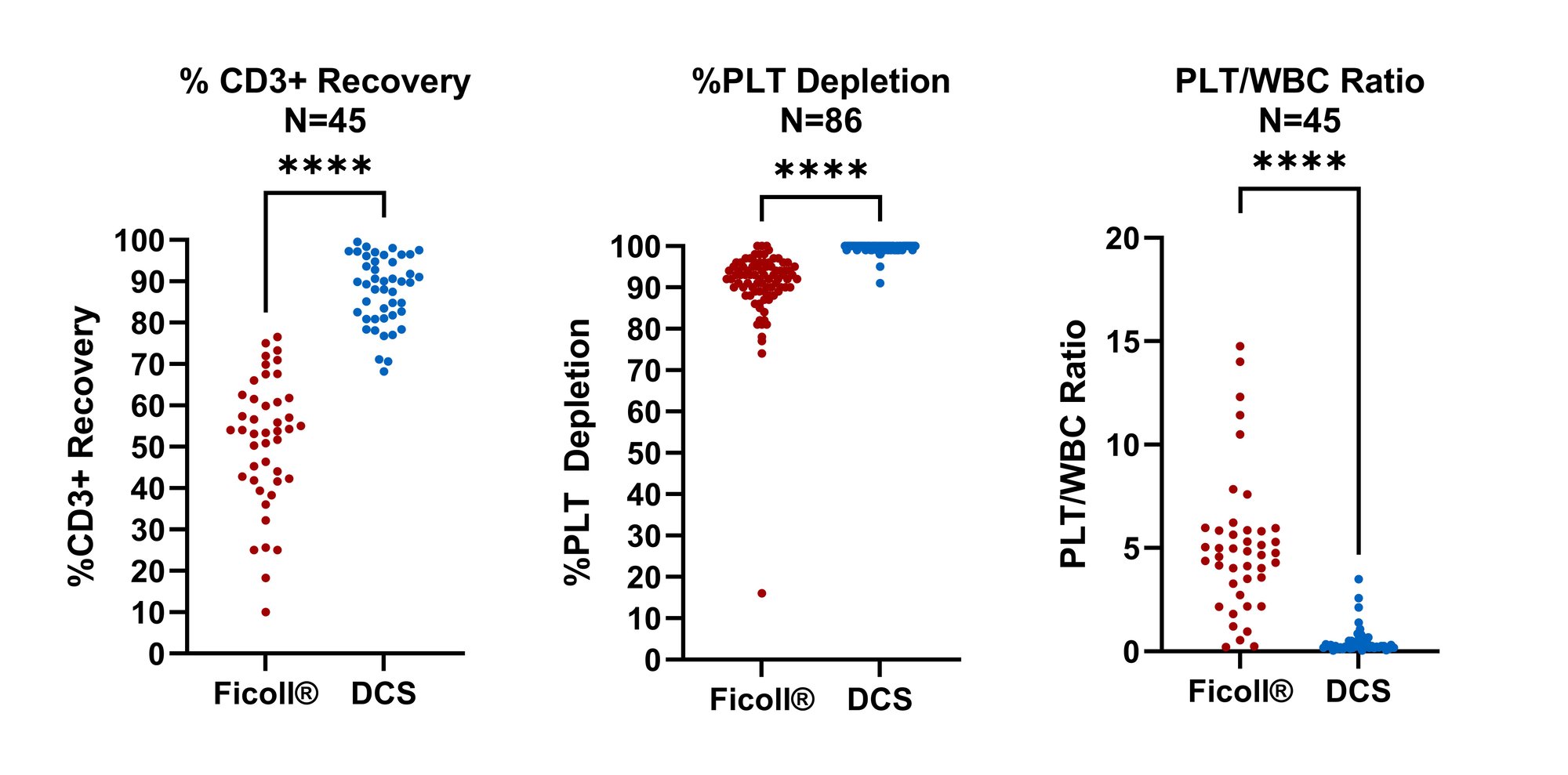
DCS recovers almost 2x more CD3+ T-cells than Ficoll®.
DCS removes >10x more platelets than manual Ficoll®.
Representative performance of the 4.3 µm device. Not a guaranteed specification.
Ficoll® is a registered trademark owned by GE Healthcare companies.
Every catalog device is for Research Use Only, built for research and process development. When you are ready to move toward clinical manufacturing, we co-develop a custom, regulated path with your team.
How it works
As cells flow through a precisely engineered array of micropillars, larger cells follow one path and smaller cells and diffusible species follow another. That physical sorting is what makes DCS label-free and repeatable.
The same principle scales. Parallelized arrays take you from small research volumes up to full apheresis collections without changing the underlying method.
Mathematically defined array geometries are designed for different critical diameters. Choose the one that fits your target cells.
See DCS technology in action - efficient cell separation for optimal therapeutic outcomes
Edge Precision is a wholly owned subsidiary of ZEON
FAQ
Common questions about DCS
Each DCS device has two fluid inputs, your sample and a running buffer, and two fluid outputs, the larger-than-critical-diameter fraction and the smaller-than-critical-diameter fraction. In every device the larger size fraction is collected in the running buffer, while the smaller size fraction stays in the original sample solution.
No. DCS devices are compatible with off-the-shelf microfluidic controllers and need only two pressure sources, so you can start without buying a dedicated closed instrument.
Deterministic lateral displacement (DLD) is the physics behind DCS. In a precisely spaced array of micropillars, particles above a critical size are bumped laterally into a predictable path, while smaller particles follow the fluid streamlines. The result is size-based separation that is continuous, label-free, and repeatable.
Magnetic bead and immunomagnetic methods separate cells by tagging a surface marker with an antibody-coated bead, then pulling the tagged cells out and removing the beads. DCS separates by physical cell size, so there is nothing to tag and nothing to strip back out. That means no antibodies, no beads, no reagent lock-in, and cells that stay label-free.
Yes. Teams use DCS in place of manual Ficoll to isolate white blood cells and PBMCs from blood. Compared with manual Ficoll, DCS gives higher target-cell recovery, strong platelet and red blood cell depletion, and less operator-to-operator variability, with no centrifuge step.
Yes. The same method scales from under 1 mL research volumes up to 300+ mL apheresis collections by running more lanes in parallel. Devices process fresh blood products including whole blood, apheresis, and buffy coats, as well as cultured and expanded cells.
DCS catalog devices are available now for Research Use Only, with no minimum order. You can buy a single device or scale throughput with more lanes. For a path toward clinical manufacturing, we co-develop a custom, regulated solution with your team.
Yes. Take the product from the 4.3 µm device (the large size fraction), then process it on an 8.5 µm device. Your target cells are collected in the small size fraction from the 8.5 µm device.
No. Generally any buffer with low to moderate viscosity works, for example water, PBS, Plasma-Lyte, or cell culture media.
Yes. DCS catalog devices are commercially available now for Research Use Only. Contact us for pricing and available configurations. For a path toward clinical manufacturing, we co-develop a custom, regulated solution with your team.
.png?width=600&height=188&name=edge%20forward%20(1).png)